
O Mundo em Pose de Paolo Rosselli: A Fotografia Depois da Imagem


© Paolo Rosselli


EN / PT

O Mundo EM POSE de Paolo Rosselli: A Fotografia Depois da Imagem

por Pedro Leão Neto

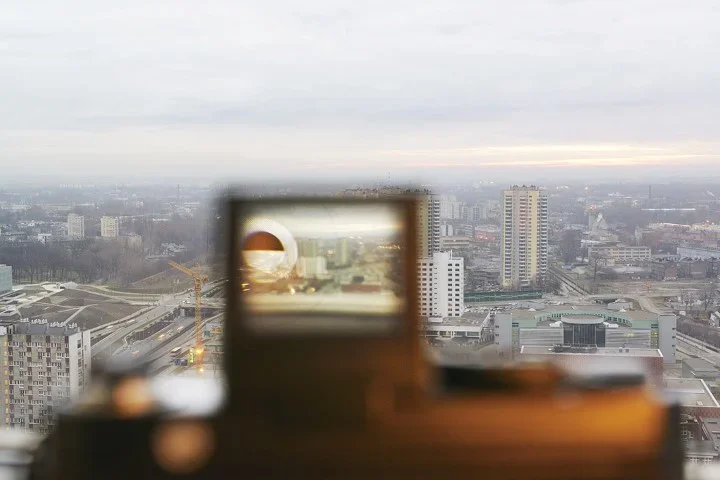
A exposição Mondi in Posa de Paolo Rosselli na Trienal de Milão, acompanhada pelo seu incisivo ensaio Posing World, chega numa altura em que a fotografia se encontra suspensa entre a exaustão e a reinvenção.

As suas imagens de grande formato, captadas em cidades de todo o mundo desde o início dos anos 2000 até ao presente, não registam apenas a arquitetura, mas também as atmosferas mutáveis ​​da vida metropolitana numa era em que, como Rosselli nos recorda, a perceção ultrapassou a representação, e a própria cidade se torna um campo vibrante e fundido de signos.

O texto de Rosselli oferece uma rara combinação de humor, crítica e inquietação filosófica. Muitas das suas reflexões abordam diretamente os desafios que os fotógrafos contemporâneos — e, na verdade, todos os criadores de imagens — enfrentam num mundo saturado de acumulação digital.

De facto, não podemos deixar de comentar algumas passagens notáveis ​​e provocatórias do seu ensaio, como quando escreve: “Será que o regresso da fotografia ao âmbito da arte socialmente responsável será indolor?” Esta questão, aparentemente simples, perpassa todo o texto. Para Rosselli, a dificuldade reside no facto de a fotografia estar cada vez mais distante da experiência corporal e do encontro ético. Ao discutir a prática de Doug Rickard — a seleção de imagens do Google Street View captadas por câmaras automáticas — Rosselli situa o trabalho dentro da linhagem documental americana de Evans e Hopper, mas também observa uma mudança crucial:

“O artista-fotógrafo não tira as fotografias; em vez disso, trabalha com imagens geradas por câmaras automáticas num momento indefinido e sem critérios conhecidos.”

No caso de Rickard, o trabalho migra do campo para o ecrã; a autoria torna-se um ato de curadoria em vez de captura. Rosselli não condena isso; Em vez disso, reconhece-a como uma resposta precoce — e honesta — ao que Baudrillard previu como a “hegemonia do digital”, o momento em que as imagens proliferam para além da intenção, para além do testemunho, para além do olhar humano.

Rosselli escreve com melancolia, mas também com lucidez, sobre a metrópole contemporânea quando afirma que “As pessoas nas ruas são a cidade… sujeitos e entidades distintos que se fundem com outdoors publicitários, cores, reflexos no vidro, automóveis”.

Aqui, Rosselli confronta a ansiedade da fotografia: o seu “terror” perante um mundo onde a profundidade histórica e o “primitivo” se retiram da vista. As metrópoles, transformadas pela estética globalizada e por experiências homogeneizadas, resistem ao papel tradicional da fotografia como testemunha da identidade local ou de narrativas enraizadas. Nesta fusão, a representação perde a sua autoridade:

“A representação… foi desvalorizada: já não garante nada, porque já não controla nada no mundo.”

No final de Posing World, Rosselli comenta a surpreendente afinidade entre a escrita e a fotografia:

“Duas artes tão diferentes em natureza e estatuto comunicam tão bem, mantendo-se fiéis a si mesmas.”

Esta “relação produtiva”, sugere, surge das suas diferenças. A escrita evoca imagens através da linguagem; a fotografia consome e faz circular imagens a um ritmo acelerado. Nesta reflexão, Rosselli alinha com o curador português Delfim Sardo¹, que insiste em muitos dos seus escritos que a fotografia ganha profundidade quando aliada ao pensamento conceptual: quando as imagens não são meramente consumidas, mas interpretadas criticamente. É ainda de referir, em relação à ligação entre a escrita e a fotografia, a forma como certos escritores descrevem o seu processo criativo e a importância que atribuem às imagens no seu interior. Para ilustrar, Orhan Pamuk, numa recente entrevista dada a Isabel Lucas e publicada na revista cultural Ípsilon-PÚBLICO 2, escreveu: "Acredito que, no fundo, a arte do romance é visual. Primeiro, o escritor tem uma imagem na cabeça e depois transforma-a em palavras, fazendo o seu melhor. Isto é um talento. Depois, há os editores que editam, os editores que publicam e, finalmente, o leitor lê aquela página e tenta formar a imagem que o escritor tinha inicialmente em mente. Portanto, é comunicação.

Com Mondi in Posa, Paolo Rosselli oferece algo urgentemente necessário hoje: não simplesmente fotografias de cidades, mas uma estrutura conceptual para as ver. As suas imagens revisitam ícones modernistas, mas com um olhar irónico, atento às contradições da cultura urbana globalizada. Acreditamos que o trabalho de Rosselli afirma a contínua relevância da fotografia como uma prática crítica, reflexiva e profundamente humana num mundo cada vez mais algorítmico, o que está alinhado com muitos dos debates mais amplos dos estudos visuais contemporâneos.

É também um privilégio reconhecer a longa presença de Paolo Rosselli na comunidade da Sophia Journal e da scopio Editions, bem como no grupo de investigação Arquitetura, Arte e Imagem (AAI), sediado no Centro de Estudos em Arquitetura e Urbanismo (CEAU) da Faculdade de Arquitetura da Universidade.

1. Sardo, Delfim , trans. 2025. “The Melancholy of Images: Reassessing the Value of Photography”. SCOPIO MAGAZINE ARCHITECTURE, ART AND IMAGE 2 (1): 1-5. https://doi.org/10.24840/1647-8274_2024_0002_0001_07

2. Orhan Pamuk: “Turkey and oppression made me a political man” by Isabel Lucas in https://www.publico.pt/2025/11/21/culturaipsilon/entrevista/orhan-pamuk-turquia-opressao-fizeram-mim-homem-politico-2155045

Triennale milano 2026
Exhibition Paolo Rosselli Mondi in posa

Curated by: Studio Paolo Rosselli In collaboration with: Francesco Paleari, Cecilia Da Pozzo, Giacomo Quinland Exhibition design: studio GISTO
 

Paolo Rosselli’s Posing World: Photography After the Image


© Paolo Rosselli


EN / PT

PAOLO Rosselli’s Posing World: Photography After the Image

by Pedro Leão Neto


Paolo Rosselli’s exhibition Mondi in Posa at Triennale Milano, accompanied by his incisive essay Posing World, arrives at a moment when photography finds itself suspended between exhaustion and reinvention.

His large-format images, taken across global cities from the early 2000s to the present, capture not simply architecture, but the shifting atmospheres of metropolitan life in an age when, as Rosselli reminds us, perception has overtaken representation, and the city itself becomes a fused, vibrating field of signs.

Rosselli’s writing offers a rare interlacing of humour, critique, and philosophical unease. Many of his reflections speak directly to the challenges that contemporary photographers—and indeed all image-makers—face in a world saturated with digital accumulation.

Indeed, we cannot resist commenting on some noticeable and provocative passages in his essay, as when he writes, “Will photography’s re-entry into the realm of socially responsible art be a painless one?” This deceptively simple question underpins the entire text. For Rosselli, the difficulty lies in the fact that photography is increasingly detached from bodily experience and ethical encounter. When he discusses Doug Rickard’s practice—selecting Google Street View images taken by automated cameras—Rosselli situates the work within the American documentary lineage of Evans and Hopper, but also notes a crucial shift:

“The artist-photographer does not actually take the photos; instead, he works with images generated by automatic cameras at no specified time and according to no known criteria.”

In Rickard’s case, labour migrates from the field to the screen; authorship becomes an act of curation rather than capture. Rosselli does not condemn this; instead, he recognises it as an early—and honest—response to what Baudrillard foresaw as the “hegemony of the digital,” the moment when images proliferate beyond intention, beyond witnessing, beyond the human eye.

Rosselli writes with melancholy but also lucidity about the contemporary metropolis when he says that “People on the streets are the city… distinct subjects and entities that merge with advertising hoardings, colours, reflections in glass, automobiles.”

Here, Rosselli confronts photography’s anxiety: its “terror” before a world where historical depth and the “primeval” retreat from view. Metropolises, transformed by globalised aesthetics and homogenised experiences, resist the traditional role of photography as witness to local identity or rooted narratives. In this fusion, representation loses its authority:

“Representation… has been devalued: it no longer guarantees anything, because it no longer controls anything in the world.”

Towards the end of Posing World, Rosselli remarks on the surprising affinity between writing and photography:

“Two arts so different in nature and status communicate so well while remaining what they are.”

This "productive relationship" comes, he suggests, from their differences. Writing conjures images through language; photography consumes and circulates images at a rapid pace. In this reflection, Rosselli aligns himself with the Portuguese curator Delfim Sardo 1, who insists in many of his writings that photography gains depth when paired with conceptual thought: when images are not merely consumed but critically interpreted. It is also worth mentioning, in relation to the relationship between writing and photography, how certain writers describe their creative process and the importance they attribute to images within it. To make a case in point, Orhan Pamuk, in a recent interview by Isabel Lucas published in cultural magazine Ípsilon- PÚBLICO 2, wrote, "I think, in essence, the art of the novel is visual. First, the writer has an image in his head and then transforms that image into words, doing his best. That is a talent. Then there are text editors who edit, publishers who publish, and finally, the reader is reading that page and trying to form the image that the writer initially had in his mind. So it is communication. It is visual communication."

With Mondi in Posa, Paolo Rosselli offers something urgently needed today: not simply photographs of cities, but a conceptual framework for seeing them. His images revisit modernist icons, but with an ironic eye attuned to the contradictions of globalised urban culture. We believe that Rosselli’s work affirms photography’s continued relevance as a critical, reflective, and profoundly human practice within an increasingly algorithmic world, which aligns with many of the broader debates in contemporary visual studies.

It is also a privilege to acknowledge Paolo Rosselli’s longstanding presence within the Sophia Journal and scopio Editions community, as well as with research group Architecture, Art and Image (AAI) based at the Center for Studies in Architecture and Urbanism (CEAU) of Faculty of Architecture, University of Porto (FAUP). Over the years, we have had the honour of welcoming him as a guest in several Sophia Journal International Conferences and of publishing both his photographic work and his writings. Notably, A Talk on Architecture in Photography: Photographs by Paolo Rosselli—presented at the Venice Architecture Biennale—and his essay “Photography on Architecture: Visual Spaces of Change – Unveiling the Transformation of Publicness” (Sophia Journal, 2019) stand as important contributions that continue to resonate deeply within our ongoing reflections on architecture, image, and the contemporary city.

1. Sardo, Delfim , trans. 2025. “The Melancholy of Images: Reassessing the Value of Photography”. SCOPIO MAGAZINE ARCHITECTURE, ART AND IMAGE 2 (1): 1-5. https://doi.org/10.24840/1647-8274_2024_0002_0001_07

2. Orhan Pamuk: “Turkey and oppression made me a political man” by Isabel Lucas in https://www.publico.pt/2025/11/21/culturaipsilon/entrevista/orhan-pamuk-turquia-opressao-fizeram-mim-homem-politico-2155045

Triennale milano 2026
Exhibition Paolo Rosselli Mondi in posa

Curated by: Studio Paolo Rosselli In collaboration with: Francesco Paleari, Cecilia Da Pozzo, Giacomo Quinland Exhibition design: studio GISTO


PRESENTATION OF THE BOOK "A TALK ON ARCHITECTURE IN PHOTOGRAPHY: PHOTOGRAPHS BY PAOLO ROSSELLI" / PRESENTATION OF THE INTERNATIONAL PHOTOGRAPHY AND DRAWING CONTEST (DPIc)

 
IMG_9752copy.jpg


EN / PT

INTERNATIONAL PHOTOGRAPHY AND DRAWING CONTEST (DPIc) - PRESENTATION OF "A TALK ON ARCHITECTURE IN PHOTOGRAPHY: PHOTOGRAPHS BY PAOLO ROSSELLI" / CONVERSATION ABOUT "ARCHITECTURE AND FICTION IN PHOTOGRAPHY"

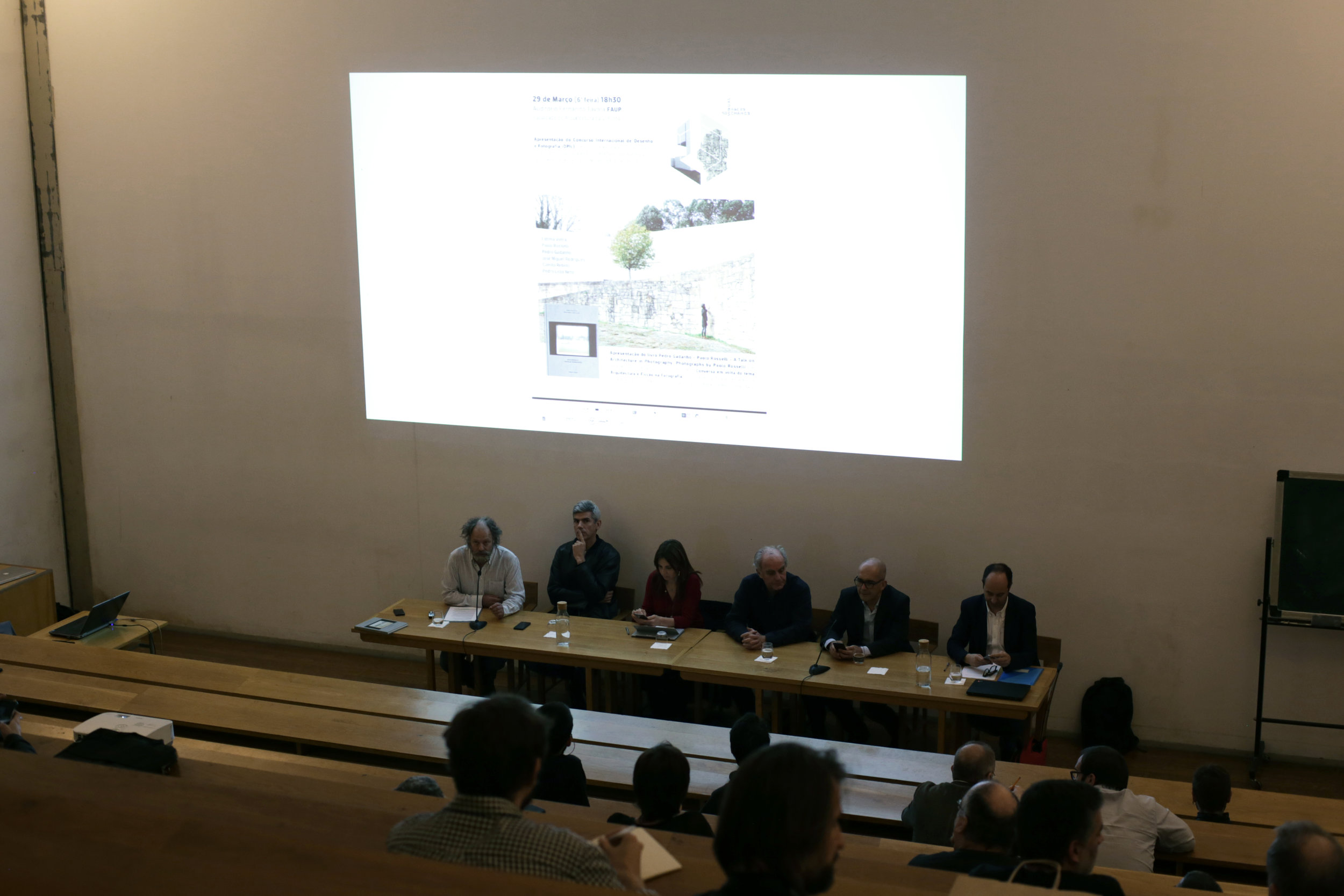
Past friday, the 29th of March, the conference "INTERNATIONAL PHOTOGRAPHY AND DRAWING CONTEST (DPIc) - PRESENTATION OF "A TALK ON ARCHITECTURE IN PHOTOGRAPHY: PHOTOGRAPHS BY PAOLO ROSSELLI / CONVERSTATION ABOUT "ARCHITECTURE AND FICTION IN PHOTOGRAPHY" took place in Fernando Távorá’s auditorium, in FAUP.

Pedro Leão Neto and Camilo Rebelo (the organizers of the DUEL/DUET (AAI) SERIES) opened the session, followed by Fátima Vieira (U. Porto Vice-Rector for Culture) who presented International Photography and Drawing Contest (DPIc): Space and Identity of the 14 Faculties of U. Porto. The next speaker was José Miguel Rodrigues (the Director of CEAU-FAUP) who presented the book of Pedro Gadanho and Paolo Rosselli A Talk on Architecture in Photography: Photographs by Paolo Rosselli, followed by a discussion between Pedro Gadanho and Paolo Rosselli about Architecture and Fiction in Photography, a conversation that was open to the participation of everyone in the audience.

A Talk on Architecture in Photography: Photographs by Paolo Rosselli
The book Pedro Gadanho - Paolo Rosselli - A Talk on Architecture in Photography: Photographs by Paolo Rosselli is the first of the four publications focused on each of the Dueto/Duelo sessions that fostered a critical debate related to Architecture, Art and Image between architects and photographers, which took place in 2016 in Casa das Artes of Porto, Portugal. The curators of this event - Architecture, Art and Image (AAI) Conference series - Duelo / Dueto - were Camilo Rebelo and Pedro Leão Neto. Having as base the talk between Pedro Gadanho and Paolo Rosselli and the rich exchange of ideas between these two authors, the book comprises a visual narrative where the sum is greater than the parts, allowing for an innovative reading and a more insightful understanding about the thoughts, work and artistic strategies of Rosselli photography.

(DPIc) - Space and Identity of the 14 Faculties of U. Porto
The International Drawing and Photography Competition (DPIc) - Space and Identity of the 14 Faculties of U. Porto: Visual Spaces of Change (VSC) is addressed to all U. Porto students and researchers. The core theme of the contest is the idea of Utopia and Visual Spaces of Change (VSC), focusing on the spaces and identity of the 14 Faculties of U. Porto. The competition is organized by the research group CCRE (FAUP) integrated in the R & D center of FAUP (CEAU) in partnership with the Student Associations of all Faculties of U. Porto, being promoters the consortium of the project, counting with the institutional support of the Rectory of U. Porto and FAUP.

Visual Spaces of Change (VSC)
Visual Spaces of Change is the first stage of an Architecture, Art, Image, and Innovation (AAI2) Project, which has a significant component of Contemporary Photography combined with complementary research in Space Syntax and Information Technology. Building on earlier research from the Center for Communication and Spatial Representation (CCRE), this project will investigate the conditions for the creation of a network of public and collective spaces capable of catalyzing emerging dynamics of urban change in Oporto Metropolitan Region (AMP). The territory of this study is simultaneously used as the laboratory for empirical experimentation and as the stage for visual representation of the agents and processes of urban change. This research project will produce visual synthesis of these dynamics in order to render visible aspects of its interconnected nature and historical singularity, which are difficult to perceive without the purposeful use of image and photography. This project breaks new ground in proposing an original combination of visual research methods and spatial analysis, departing from the identification of a set of strategic city spaces and pathways connected by network points (VSCNP) identified in the urban grid. These network points are calculated by using syntactic measurements, which allow for the identification of the location of optimal interaction between public and collective spaces. Contemporary Photography Projects (CPP) will be developed and implemented in the selected locations, conceived as visual narratives that intentionally interfere with the metropolitan territory in a self-reflective representation of its own process of change.