1 PHOTO(GRAPHER): PAOLO ROSSELLI


1 PHOTO(GRAPHER): PAOLO ROSSELLI

BY HUGO OLIVEIRA


HO: Where was this photograph shot?

PR: It was shot in the room of the hotel where I was staying in Katowice, in Poland.

HO: When was it shot?

PR: It was shot in January, 2014. It's my most recent work.

HO: What type of atmosphere of Katowice were you trying to reflect through this photograph?

PR: Firstly, I think that there is a confusion between the "inside" and the "outside". Then there is a confusion between two subjects: landscape and camera. And then there is a view in the second camera which is blurred. So I really like to put these things together.

HO: What made you select this photograph?

PR: First I must say that it is not a real collage. In a way, as a photographer I see the world as a collage, it is artificial, it is built. It is sort of “fake” thing. But at the same time very real. This set is not made with Photoshop, it's made by me. I like to put things together that have no relation. Normally you see the landscape as a landscape. My view of the world is already a collage, it's a sort of a “set”. I think about the “set”, I prepare it, and then I go around the city, and I try and propose to see the world in this way.

So, this series – with the camera “inside the picture” - is something that I conceived around one year ago. I started to put the camera as a subject inside the photo that looks at the landscape. So, the world for me is not “reality”, it is a “set”. In my opinion, there is a difference in the perceiving of the world before and after digital photography arrived - let's say, ten years ago. In my view this change came with other changes in the view of the city. The growth of cities “exploded” in the last 30 years. If you go to China you perfectly understand that! It's a chaos. But nevertheless a very interesting chaos. And in my view, all of these changes - urban, technical, etc. - came at the same time. It influenced the perceiving of the world by the photographer. And as a photographer, I react to these changes through my work.

HO: What do you like the most about this photo and is there anything valuable to take out of this experience?

PR: What I like in this picture that I took - or any other that I take inside of a room or of a car - is that I can put together two experiences. The experience of the inside and the experience of the outside. If I was in a helicopter I could only see the experience of the outside through a medium (a drone or a helicopter). This is not interesting for me. I cannot compose the image as I do, through a drone.

HO: What is the importance of storytelling and narrative in your work?

PR: I think that ideas, words, or concepts lead me in taking a particular picture. That is very important in my point of view. Otherwise, I think that, while taking pictures of architecture is a very interesting thing, in the end you need to think about what you are doing as a photographer.


Paolo Rosselli is an Italian architecture photographer based in Milan.

The image and interview selected are part of the editorial project "1 Photo(grapher)".


1 PHOTO(GRAPHER): ALASTAIR PHILIP WIPER


1 PHOTO(GRAPHER): ALASTAIR PHILIP WIPER

BY HUGO OLIVEIRA


HO:  Where and when did you take this photograph?

APW: This photograph was shot in a storage warehouse a CERN, Geneva, Switzerland, on May 15. 2013, at 10:36.

HO: How was the atmosphere there?

APW: Quiet, a bit dusty, mostly overcast as there was a big warehouse door open to the left of the picture and it was a cloudy, rainy day outside.

HO: Any technical aspects about the shooting that you want to point out?

APW: I used a digital camera and a tripod, with a shutter release cable, and the available light.

HO: How did you get in?

APW: I am doing a long term personal project about the facilities at CERN, so I have some contacts there that get me access.

HO: Had you been there before?

APW: I have been to CERN before, but never in that building.

HO: What do you find most interesting about this image?

APW: The large circular object is a full scale plywood replica of part of the ATLAS Experiment, one of the particle detectors on the Large Hadron Collider, which was built to train the engineers how to install different parts of it. I'm not sure if it has been used since the construction of the detector was completed in 2008, we found it at the back of a storage warehouse. There are a lot of things that work for me in this image: the playfulness and contrast of having something so technically advanced replicated in wood; the representation of something that is the most advanced machine that has ever been built by mankind put at the back of a warehouse and forgotten about; the way the circles are aligned.


Alaistair Philip Wiper is an English photographer based in the Copenhagen.

The image and interview selected are part of the editorial project "1 Photo(grapher)".


1 PHOTO(GRAPHER): LEONARDO FINOTTI


1 PHOTO(GRAPHER): LEONARDO FINOTTI

BY HUGO OLIVEIRA


HO: Where was this photograph shot?

LF: In Icaraí-Grajaú, in the outskirts of the southern area of ão Paulo, in Brazil.

HO: When?

LF: On November 3, 2011, at 10.28am.

HO: Is there any technical aspect of the photograph that you want to mention?

LF: The fact that shooting was done in a helicopter brought some technical issues to light. For example, to avoid a blurred image I had to use a higher speed. The use of till-shift lenses in an helicopter flight is very difficult task to be performed, because these are fully manual lenses that do not allow things like autofocus or the possibility to set the shutter speed. On the other hand, the most important in this picture is the framework. To find an extremely accurate perspective as I do in my nomal work by foot.

HO: How did the opportunity show up?

LF: The work was commissioned by the Municipal Housing Department, which was investing in many sports and leisure facilities on the outskirts of the city of São Paulo.

HO: I had been in that area before?

LF: No, but walked there a few days later.

HO: Why did you choose this image? What's most interesting about it?

LF: The photo is part of an authorial work which I'm developing right now which will be shown at an exhibition in Rio de Janeiro along with a book published in Switzerland. Also, because it has a special meaning in the context of the World Cup (2014 in Brazil).

HO: Was there anything you were trying to communicate through it?

LF: My photography work ends up structuring the reality that I photograph. In a architecture project finding this structure is always easier because it is designed by an architect and has all of those things really well defined, the informal city does not. In this image the football field/slum is "architectuized" by my way of seeing; the structure of the field goes through the slum, but it all happens in the picture, the picture creates a structured reality.

HO: Is there any peculiar story about the photograph that you want to share?

LF: I did a lenticular print this photo as a test, which consists of two overlapping extensions, at the back with paper and at the front with translucent frame, and it created a strange kind of 3D motion, which changes depending on the position of the observer. We put it in the office and everyone hated it. Two days later we had a meeting there with a curator who saw the photo and said, "Don't show this to anyone, we will make an exhibition". That is the exhibition I am working on now. Everybody sees different things in photography!


Leonardo Finotti is a Brazilian architectural photographer.

The image and interview selected are part of the editorial project "1 Photo(grapher)".


1 PHOTO(GRAPHER): SEBASTIANO RAIMONDO 


1 PHOTO(GRAPHER): SEBASTIANO RAIMONDO 

BY HUGO OLIVEIRA


HO: Where did you shoot these photographs?

SR: These photographs were shot in the territory of Castelvetrano, in Sicily, Italy. In my work it is very common to use images together has diptychs or triptychs. The first one shows the construction of the town hall (designed by architect Santo Giunta, 2005-2008) and the second one is of the temple "E" in the archaeological area of elinunte (460-450 BC).

HO: When were they shot?

SR: The first one in the Spring of 2007, the second one in the Spring of 2011.

HO: Is there any technical aspect about the process that you want to point out?

SR:  These were shot on film, like most of my work, and then scanned and printed by me.

HO: How did you get to the sites?

SR: The first access to sites was through comission. I worked as an architect in the office that designed the Castelvetranho town hall building and I often visited the archaeological area where the temple is. Both architectures have a clear place in the landscape and a relationship with the public space, although both also in very different ways.

HO: Was there something that you wanted to communicate throught these two images?

SR: I think the diptych may suggest to the viewer - an architect, or not - a reflection on the concept of ruin and of time.

The two photographs, which don't show people, showing the same territory, set a fragment on the evolution of both buildings; the power of the sequence is in the illusion that the two building can advance in relation to the finished form of a pre-existing project, something that already exists in represented in a way, or in relation to the ruin of all artifacts which slowly return - with the help of nature and of the cultural meaning attributed - to a form which can be pre-visualized.

Whatever is the fate of any of those buildings, the photographic image is at the intersection of the two timelines, and as a manifestation of the author's experience, it is a bridge with endless possibilities of reading by any viewer.

HO: Was there anything that you discovered through this diptych?

SR: I realized that the photographic work exists beyond the represented object; its existence is concrete, changeable, and it also lives beyond its author.


Sebastiano Raimondo is an Italian architect and photographer based in Palermo.

The image and interview selected are part of the editorial project "1 Photo(grapher)".


1 PHOTO(GRAPHER): OLIVO BARBIERI


1 PHOTO(GRAPHER): OLIVO BARBIERI

BY HUGO OLIVEIRA


HO: Where and when was this photo taken?

OB: It was shot in Houston, state of Texas (USA), in the Summer of 2012.

HO: What were the conditions there?

OB: It was very hot and sunny and there was no wind.

HO: How did this opportunity come up?

OB: I went to Houston to shot it because it is part of my project “site specific_” about the form the contemporary city.

HO: Are there any particular technical aspects about the photo that you want to point out?

OB: Well, I was shooting from an helicopter, 500 feet above ground.

HO: Why did you select this image?

OB: I selected this image because I found it was interesting to question how and why urban planners or architects and developers decided it was right and necessary to put a kind of Aztec temple on top of a sky scrapper.


Olivo Barbieri is an artist and photographer.

The image and interview are part of the editorial project “1 Photo(grapher)”.


1 PHOTO(GRAPHER): FRANCISCO NOGUEIRA


1 PHOTO(GRAPHER): FRANCISCO NOGUEIRA

BY HUGO OLIVEIRA


HO: Where and when was this photograph shot?

FN: This was shot at the “Boa Entrada” Main Country House, in São Tomé and Príncipe, April 4th, 2013, 12:38.

HO: What were the conditions on site?

FN: The weather was really hot and humid which makes the body be permanently sweating. The smell and sound of the “roça” (country house) is very peculiar. You can hear roosters, goats, kids playing, balls. Because of its configurations and because they are open glades, the very own acoustics of “roças” are special. The smell is also very characteristic, mainly because in the majority of “roças” people and animals cohabit the same spaces. In those places where cocoa is dried there is also a very particular odor.

HO: Are there any technical aspects about the shooting  that you want to point out?

FN: I used a full-frame digital camera and tilt and shift lens.

HO: How did you opportunity happen?

FN: This photograph is part of a work I did for the book “As Roças de São Tomé e Príncipe” (Tinta da China, 2013) in co-authorship with architects Duarte Pape e Rodrigo Rebelo de Andrade. We visited and catalogued 122 “roças” which Duarte and Rodrigo had already identified through a research they were developing at the time. The way we got inside the “roças” was always the same: get in and try and establish a dialogue with the local communities, trying to explain the project and asking for permission to photograph the place. The people of São Tomé are very open and friendly, which meant that in the majority of times there was no problem establishing that connection that allowed us to do our work.

HO: Was this the first time you were there?

FN: It was my first time in São Tomé and Príncipe, but both Duarte and Rodrigo had already been at Boa Entrada “roça” 4 years before and they could see the glass and woodwork of this bow window completely intact.

HO: Why did you select this image?

FN: From all the ones from the “Roças de São Tomé e Príncipe” project I chose this one because I felt that this one encapsulates some of the things that make this reality unique and which should be valued urgently. On one hand it shows the richness of this heritage, on the other hand its very advanced state of degradation. Also because it shows the very social character which is so present and so inseparable from this heritage.

HO: What do you find most interesting about it?

FN: I like this project and particularly this image because of the pleasure it gave to me to do it. It made me realize what type of work do I like the most to do. Somewhere between architecture, travel and reportage.

HO: Is there anything you were trying to communicate through this image?

FN: This entrance area as well as the bow window were added to the original house. It was built in order to receive Prince Luís Filipe at the “roça” while he was visiting São Tomé and Príncipe in 1907.


Francisco Nogueira is an architectural photographer based in Lisbon.

The image and interview selected are part of the editorial project "1 Photo(grapher)".


1 PHOTO(GRAPHER): WALTER MAIR


1 PHOTO(GRAPHER): WALTER MAIR

BY HUGO OLIVEIRA


HO: Where and when was this photo taken?

WM: This is a shot of the stage of the Schauspielhaus Köln (theater), in Cologne, Germany

HO: When was it shot?

WM: In February 2013.

HO: What were the conditions in the space?

WM: Room temperature, heavy bright-dark contrasts from the fluorescent lamps, sound-check in the background, no smell, many people bustling around.

HO: How did you get into the building?

WM: It was through a commission by the Schauspielhaus Köln, Cologne, initiated by the director, Anna Viebrock.

HO: Had you been there before?

WM: Yes, I attended a series of rehearsals for this play to do the pictures for the programme and also for the press.

HO: Why is this photograph so important for you?

WM: The subject matter of the play and of the set design contemplates very much the work of the German artist Gregor Schneider and his "Haus u r" The set design and the decor is partly a reconstruction and recombination of some of the interiors by Gregor Schneider. There is also a very iconographic photograph by the artist with a sculpture of a dead body lying on the floor. The intention was to re-enact this tableau. "My" picture stands for now at the end of a long row of other images and ideas: Gregor Schneider's initial thought and the actually built or transformed space and scenery, photographed and published by Schneider; seen by Anna Viebrock and again transformed and reproduced as the set for the Schauspielhaus Köln, with an actor playing the dead person. It seemed to me as if Sachiko turned the screw even more and did not only play a dead person but could transform herself to this very initial lifeless sculpture made only of shoes, some cloth, stockings, sponge and dust.


Walter Mair is a photographer and architect based in Zurich.

The image and interview selected are part of the editorial project "1 Photo(grapher)".


1 PHOTOGRAPHER: TIM VAN DE VELDE

 
timvan.jpg

1 PHOTOGRAPHER: TIM VAN DE VELDE

BY HUGO OLIVEIRA


HO: When and where was this photograph taken?

TV: The photo is one of the Brüder Klaus Field Chapel in Mechernich-Wachendorf, in Germany.

HO: When was it taken?

TV: In  March 15th 2013m at 14h15, but for me that is not that relevant.

HO: What were the conditions there on site?

TV: Although it was already late in the year, the weather conditions were exceptional. There was still snow at that time of the year which does not happen every year, by far. The weather was very capricious that day. At one time you had sun but five minutes later cold windy fog could pass by and snow showers were pinning like needles in your face.

HO: How did you get to the site?

TV: I went to the site on my own hunch. I had been thinking about photographing it for a while just for myself, but when I woke up that day I saw that a big amount of snow had fallen again and weather was open in Brussels. So I decided to get in my car and make the drive to the Chapel. As an architectural photographer you can be drawn to a building and for the Chapel this was certainly the case. The chapel had been photographed before, but I hadn't seen any photos of it in the snow. For me it was a necessity that my photographs were shot with snow. It gives the chapel a more isolated character.

HO: Had you been there before?

TV: No, it was a first time for me. Often I like to photograph sites the first time I get there. I like to take the time then to discover the building and start shooting it during a day while the building little by little reveals itself.

HO: What do you find most interesting about this photo?

TV:  I like the fact that it is a quite straight forward shot of the path under the snow that leads to the chapel surrounded by snow. But it works. Often the simplest of shots work the best. I like the correlation between the environment and the chapel. The open door intrigues somewhat mysteriously but draws you inside. The fence on the left only gives you that option to go to the Chapel. In the back you see the environment of the hills and woods.

HO: Is there any peculiar story about this shooting?

TV: Although the chapel is somewhat isolated outside a village, it is a place of religious prayer and architecturally interested. So people pass by often and enter of course. For this shot I had to get it on the right time, which meant waiting. Here, although the place looks abandoned a person had just entered the chapel for prayer.

HO: Was there something you wanted to communicate through it?

TV: For me architectural photography is often a solitary experience. You work alone and try to grasp the right shots by discovering the building. On this location, where you have to make an effort to get to the chapel with your gear and the totality of weather conditions and the religious character of the chapel made this experience more intense. To me this image has this feeling in it. It was a sort of architectural pilgrimage.


Tim van de Velde is an architectural photographer based in Brussels.

The image and interview selected are part of the editorial project "1 Photo(grapher)".


1 PHOTO(GRAPHER): JUAN RODRIGUEZ

 
45_-_juan_rodriguez.jpg

1 PHOTO(GRAPHER): JUAN RODRIGUEZ

BY HUGO OLIVEIRA


HO: Where and when was this photograph shot?

JR: This photo was shot in Chicago, in 2005, through my hotel room window, looking at the John Hancock Tower. It was late afternoon, while I was preparing my exhibition about Patagonia. That exhabition was held in that building.

HO: Can you specify any technical aspects about the photograph?

JR: It was shot with a Leica M6 and the negative was scanned. The final copy was done with japanese rice paper and printed with mineral ink.

HO: Why did you select this image?

JR: It's part of an exhibition called "Beyond Black" about my own way of looking at architecture. It's part of a bigger discourse.

HO: Was there anything you wanted to communicate through it?

JR: Nothing in particular. But maybe just to say that the texts for the "Beyond Black" book are written by Portuguese friends like Pedro Cabrita Reis and Eduardo Souto de Moura.


1 PHOTO(GRAPHER): MARGHERITA SPILUTTINI

 
_51_-_margherita_spiluttini.jpg

1 PHOTO(GRAPHER): MARGHERITA SPILUTTINI

BY HUGO OLIVEIRA

HO: Where was this photograph shot?

MS: The photo was taken in Weerberg-Innerst, a small village in the Alps, situated in a side valley between Wattens and Schwaz in Tyrol, Austria, 1300m above sea level.

HO: When was it shot?

MS: In October 1996.

HO: What were the conditions?

MS: Weather conditions are apparent to the observer on first sight. They are an essential element of the image. Also quite dominant was the smell of a manure heap on the neighboring property. (It is not shown on the particular image but on another photo of this series.)

HO: Are there any particular technical aspects you want to point out?

MS: No, no specific technical aspects. 4x5'', ektachrome film.

HO: How did you get to the site?
MS: By the client who is the architect of the house, Mrs. Margarethe Heubacher-Sentobe.
HO: What do you find most interesting about this image?
MS: In the Alps, especially in the Fall, fog is a frequent weather phenomenon. It contributes to that the mountains are not only perceived as impressively beautiful, but also as threatening and mysterious. Although the building itself is shown in a "shadowy" way and is only vaguely visible, this image was published very often and has obtained a certain degree of prominence.

HO: Is there anything that you were trying to communicate through it?
MS: It is worth to explore a place photographically, especially when circumstances do not correspond to the generally accepted perceptions of "ideal" preconditions. It generates indications that often point out to the qualities of architecture and space more effectively than conventional harmonizing ways of expressions can do.

Margherita Spiluttini is an architectural photographer based in Wien.

The image and interview selected are part of the editorial project "1 Photo(grapher)".


1 PHOTO(GRAPHER): JIM STEPHENSON

 
37_-_jim_stephenson.jpg

1 PHOTO(GRAPHER): JIM STEPHENSON

BY HUGO OLIVEIRA

HO: Where and when was this photograph taken?

JS: The image is of The Serpentine Gallery's Pavilion for 2013 in Hyde Park, London, England. It was taken at 9:38am on June 4th, 2013.

HO: Was it the first time that you had been there?

JS: I'd been visiting the site for a number of weeks on a commission to document the construction of the pavilion. This was my last day on the job, the opening of the completed structure.

HO: What were the physical conditions on site?

JS: The light was especially good, given the temperamental nature of British summers. The sun was out and the morning haze had lifted. The day was beginning to warm up and I was comfortable in a t-shirt, especially having carried my heavy photographic equipment across the park. Hyde Park is a huge green space in central London and as such combines the peacefulness of a park with the hum of distant traffic to remind you you're still in the city.

HO: Are there any special technical aspects about the photograph?

JS: This is a pretty unsophisticated image, in a technical sense. Whilst photographing the pavilion on it's opening day, I noticed a scrum of press agency photographers clamouring for a photo, so I took my camera off it's tripod and shot it handheld. I ran off a couple of frames and wound up liking this one the best. The foreground (right of frame) is important both for context and to frame the scrum, and as with almost all of my work the vertical planes are at least vertical.

HO: What do you find most interesting about this image?

JS: This building only existed for a matter of months before being taken down (it was planned as a temporary structure) and over the summer it was photographed many, many times by lots of different people, not least on it's opening day. I find this idea, of a scrum of photographers photographing a building quite humorous and perhaps casts a different eye over it. This sort of behaviour is usually the reserve of paparazzi spotting an A-list celebrity. Here, the building is the superstar.

HO: Is there anything that you were trying to communicate through it?

JS: This picture wasn't one I planned to take. It's was very much an impromptu moment, so I can't say I was trying to communicate anything in particular through it. That said, once my images were released and started to be used by magazines, newspapers, blogs and so on, this one usually ended up being the most popular one! I like to show people reacting to architecture and using the space in my work as much as possible and this is at the far end of that - an extreme reaction that is tinted with humour. I goes to show that it's not always the images you think that will have the widest appeal!


Jim Stephenson is an architectural photographer and film-maker. 

The selectect image and interview are part of the editorial project "1 Photo(grapher)".


1 PHOTO(GRAPHER): SIMON KENNEDY

 
21_-_simon_kennedy_1.jpg

1 PHOTO(GRAPHER): SIMON KENNEDY

BY HUGO OLIVEIRA


HO: Where and when was this photograph taken?

SK: At the Heygate Estate (Elephant and Castle, London, England), in November 2011.

HO: Had you been there before?

SK: I visited this site on numerous occasions, also I used to live nearby and have been aware of it for many years.

HO: How did this opportunity come up?

SK: I went there specifically a number of times to make this series of images.

HO: What were the condition on site?

SK: Cold, winter, grey morning. The estate was eerily quiet as most of the inhabitants had moved out. It smelled like London.

HO: Are there any technical aspects about the photograph that you want to point out?

SK: This image was the result of a protracted process of investigation and composition, beginning with a digital camera, and ending with the use of a large format camera. The negative was scanned and subjected to a number of digital augmentations.

HO: Why did you select this image?

SK: This image is probably my favorite from the series. I like the fact that the composition is close to symmetrical, but the trees appear to be thriving, even dancing through the space. The image contains a car, suggesting some degree of inhabitation lingers on.

HO: Is there any particular story that happened during the shooting?

SK: While making this series I often ran into film crews who tried to make me move or leave the site. Since they had no authority to do this, I refused to.

HO: What did you want to communicate through this image?

SK: This image is part of a series examining this estate, which while utopian in intent was notorious through its later lifetime for social problems. These photographs were taken when the estate was empty and awaiting demolition and I am curious to see what remains – can the formal architecture reassert itself now that the inhabitants are gone, does the estate make more sense as an empty artefact than it does full? The estates reversing relationship with nature also fascinates me.


Simon Kennedy is a London based architectural photographer.

The image and interview selected are part of the editorial project "1 Photo(grapher)".


1 PHOTO(GRAPHER): NICOLAS GROSPIERRE

 
24_-_nicolas_grospierre.jpg

1 PHOTO(GRAPHER): NICOLAS GROSPIERRE

BY HUGO OLIVEIRA


HO - When and where was this photograph shot?

NG - This was shot in an Indoor swimming pool, at a Balneological Sanatorium in Druskininkai, Lithuania, in October 2003.

HO - What was the sort of conditions on site?

NG - The conditions on site where typical of that of an abandoned building: mild temperature but quite humid, rather dark but contrasty lighting, the silence was interrupted periodically by dripping water droplets, the smell was that of moulded gypsum. On the whole, it was a rather unpleasant atmosphere.

HO - Can you pecify some technical aspects about the shooting?

NG - The actual taking of the picture was quite elementary: long exposure and small aperture for wide depth of field. I used a very wide angle (40 mm) on a Hasselblad camera

HO - How did you get inside?

NG - I broke into this abandoned structure. It was locked, but not all the entrances were hermetically sealed, so I managed to get inside without breaking any windows. I learned about this building through a vintage Soviet book on architecture entitled "The architecture of Soviet Lithuania".

HO - Was it your first time there?

NG - I had been a few weeks earlier on the site, but was not utterly satisfied with the results, and therefore I decided to make another trip to make additional pictures.

HO - Why did you select this image?

NG - I selected this image because it is quite representative of my work, as far as my documenting little known Soviet architecture. I have a strong feeling to the whole series that this image is part of - entitled Hydroklinika - because it is one of the most original and delirious concrete buildings I was able to photograph, and also because it does not exist any longer in this particular form. The whole structure was transformed into an aquapark, and the interiors were destroyed in the process.

HO - What were you trying to communicate through it?

NG - Well, in this part of my work (the documentation of modernist architecture, mostly from the former socialist countries),  I try to convey as objective as possible a view on buildings I deem interesting. Of course, the choice of buildings is subjective, and reflects my preferences, and here one should look for the meaning of this work, and not in the single image. I have been documenting this kind of architecture for 13 years now, because when I started to do it it was quite neglected and unknown. I thought it was interesting because it broke the conventional thinking about socialist architecture (namely that it were mostly boring grey blocks of flats), and that, on the contrary, there were extraordinary gems that should be exposed - and perhaps salvaged. Also, this sometimes crazy architecture showed yet another side of the communist system, that it were able to produce an architecture which need not be economically viable to see the light of day. By this, I am not trying in any way to justify this system, I am simply pointing out that this feature, which ultimately led to its demise (precisely because of the lack of economic accountability) produced also extraordinary results.


Nicolas Grospierre is a Warsaw based photographer.

The image and interview selected are part of the editorial project "1 Photo(grapher)".


1 PHOTO(GRAPHER): GIGI CIFALI


1 PHOTO(GRAPHER): GIGI CIFALI

BY HUGO OLIVEIRA


HO: Where and when was this photograph taken?

GC: It was taken at the Chadderton Baths, in 2008. It's part of a photographic project called "Absense of Water".

HO: What were the conditions at the site?

GC: Well, some of them were well taken cared of, for example the Soho Baths in London, and Victoria Baths in Manchester. But many of them, even if they were protected by an alarm, were vandalized. The sound of pigeons made these places very spooky,

HO: Are there any particular aspects about the shooting that you want to point out?

GC: Not really. It was important to stay at 3/4 away from the deep end of the pool and make sure the camera - a Hasselblad  503CW - was well centered inside the tank.

HO: How did this project start?

GC: I explored the first site Hornsey baths - now demolished - which was at few steps from my apartment. After that excursion, I started searching for others.

HO: Why did you select this project?

GC: I selected the Chadderton Baths for its beauty deco-style: the white tiles and clear lines made it one of my favorites.

HO: Is there any peculiar story about this photograph?

GC: There is a funny aspect about the permit to photograph these baths. In most cases, the Council rejected the initiative. So, I needed to plan a way to climb inside. In order to find the best access to the building, I would study the planimetry of it, and find myself in weird positions. For once, I did convince the builders to had the access to this particular bath just few hours before its demolition.

HO: What is the most interesting thing about this photograph? What does it reflect?

GC: I have always been interested in memories and in the disappearance of signs that would evoke and testify our history.


Gigi Cifali is an Italian photographer based in Milan and London.

The image and interview selected are part of the editorial project "1 Photo(grapher)".


1 PHOTO(GRAPHER): EDDY JOAQUIM

 
17_-_eddy_joaquim.jpg

1 PHOTO(GRAPHER): EDDY JOAQUIM

POR HUGO OLIVEIRA

HO: Onde e quando foi esta fotografia registada?

EJ: Em La Tourette, em França, na manhã de 7 de Julho de 2001.

HO: Quais eram as condições no local?

EJ: A temperatura era amena. A primeira luz da manhã, longas sombras, ligeiramente difusas, serenidade. Os sons sugeriam um mosteiro totalmente funcional e em funcionamento. Serenos devido à função do edifício mas também pelo simbolismo de um local sagrado. O ar estava ligeiramente húmido e fresco, particularmente no sítio onde foi tirada a fotografia, que estava ligeiramente debaixo de terra.

HO: Existe algum aspecto técnico que queira mencionar?

EJ: A imagem foi tirada em rolo fotográfico e por isso está com um pouco de grão e não muito focada devido à pouca iluminação no interior e ao alto contraste proveniente das aberturas de luz acima. Ao longo dos anos, à medida que revisitava esta imagem, as imperfeições técnicas transmitem-me a ideia de que a mesma imagem é verdadeira tendo em conta a minha memória do loca. Possivelmente, as cores foram acentuadas devido ao tipo de rolo fotográfico usado, mas mesmo assim sinto que é a imagem é verdadeira na minha memória do local. Recordo-me que as cores eram muito intensas, em directo contraste com as percepções que eu tinha das obras de Le Corbusier, frequentemente publicadas através de fotografias a preto e branco que pareciam quase clinicas e desprovidas de vida. Quando se está no local é totalmente o oposto e esta fotografia recorda-me isso mesmo.

HO: Como surgiu a oportunidade de fotografar esta obra?

EJ: Por meu próprio interesse. Sou formado como arquitecto e exerço arquitectura e faço questão de visitar edifícios notáveis sempre que posso, tanto para aprender fotografia como para fotografar.

HO: O que é mais interessante para si nesta imagem?

EJ: As cores vibrantes e aparente fortuita composição formal que de alguma forma estava espacialmente muito equilibrada.

HO: Existe algum momento particular ou engraçado sobre este registo?

EJ: Infelizmente não foi uma situação engraçada, mas de qualquer forma muito presente na minha memória. O comboio que me levou à localidade próxima de La Tourette colheu uma pessoa. Ficamos presos numa área rural francesa por algum tempo, enquanto a polícia investigava o que se tinha sucedido. Nunca me esquecerei do som do impacto, que foi imperceptível até ao momento em que compreendemos porque razão o comboio tinha parado subitamente no meio do nada. É uma estranha memória para associar à tão maravilhosa experiência de visitar um edifício tão notável e tranquilo, no entanto estranhamente apropriado, um complemento à beleza inesperada do edifício.

HO: Existe algo que quisesse comunica através desta imagem?

EJ: Bem, ao longo de anos, nas viagens subsequentes que fiz a outros edifícios de Le Corbusier não apenas reforçaram a minha admiração pela humanidade dos seus espaços. Eles são muito mais do que sensorialmente sedutoras e confortáveis do que alguma vez alguém possa pensar olhando apenas para uma fotografia!

Eddy Joaquim é fotógrafo e arquitecto.

A imagem e entrevista seleccionadas fazem parte do projecto editorial "1 Photo(grapher)".


1 PHOTO(GRAPHER): DUCCIO MALAGAMBA


1 PHOTO(GRAPHER): DUCCIO MALAGAMBA

BY HUGO OLIVEIRA

HO: Where was this image taken?

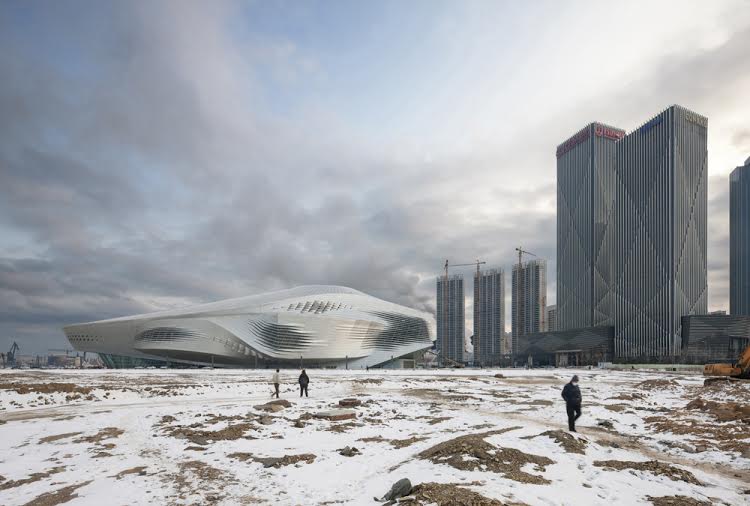
DM: It is an exterior image of the Dalian Congress Centre in Dalian, China by Coop Himmelb(l)au Architects.

HO: Had you been there before?

DM: No, it was my first time in Dalian and just my second trip to China.

HO: When was is taken?

DM: I can remember that the photo was taken in the afternoon of a day at the beginning of December 2013.

HO: How did you end up registering this?

DM: I was commissioned by the architects to portrait their building.

HO: What were the conditions at the site?

DM: The area is close to the seaside and at the moment of the shooting there was a chilly sea breeze. Very chilly, actually, as in those days the temperature was around 10/15 degrees below zero. The site was almost silent as the workers already ended their working day and the traffic was far away. The entire afternoon had been cloudy, but getting closer to the sunset the sky opened up a little and a mild light timidly appeared.

HO: Are there any technical aspects of the photograph that you want to point out?

DM: Well, to work in cold conditions is always very demanding, both for the photographer and the equipment. Nevertheless I have to point out that in one week of work under those harsh climatic conditions I never had specific problems with the batteries or the camera.

HO: Why did you select this image among so many others?

DM: I find many reasons to like this image. First of all, I love its surreal atmosphere. The three figures look very small and lost in such an unusual surroundings, I also find very funny that the closest one wears a safety mask. This detail immediately transmits the sensation of an unsafe ambience. It somehow contributes to convert the Congress Centre into a space ship that possibly contaminated the area. Or perhaps the ship is there to evacuate the surprised and disoriented survivors from this post disaster landscape… I find the image satisfactory also looking at it from a more orthodox point of view: thinking to it just as an architecture photography it shows the building perfectly lightened, enhancing the peculiarity of its form and reflecting skin. The relationship with the surroundings is clearly expressed and finally the figures add scale and some action. Another aspect I like of this image is its balanced composition with almost one half of the image dominated by a “crescendo” of dark other half relying on a bright horizontal volume.

HO: Was there anything particular that you were trying to communicate through this image?

DM: I was definitely interested in showing the very peculiar context where the building was standing and I was fascinated by the contrasts in terms of scale and aesthetic. But let me reproduce what Architectural Review’s Editor Catherine Slessor said about my picture during an interview in port-magazine.com. She perfectly describes what I had in mind and, of course, she is able to express it much better than I could ever do when we come to English:

“It’s simultaneously beautiful and bleak – the beautiful new building like a delicate piece of sculpture or haute couture set against the backdrop of a still terraforming cityscape of bleak and anonymous skyscrapers. It’s exceptionally evocative of our times and how architecture is being relentlessly commodified, used as a bauble to prettify what is essentially a terrifyingly banal and overscaled urban development being realised at breakneck speed. By pulling back to include the wider context, Malagamba invites you to consider a much more revealing and complex picture.”

Duccio Malagamba is a photographer and architect.

The selected image and interview are part of the editorial project "1 Photo(grapher)".


1 PHOTO(GRAPHER): DAVID LEVENTI

 
29-david-leventi.jpg

1 PHOTO(GRAPHER): DAVID LEVENTI

BY HUGO OLIVEIRA


HO: Where and when was this photograph shot?

DL: It was shot in the Koepel Panopticon Prison, Arnhem, in the Netherlands, May 23, 2011 at 8:44pm.

HO: What were the conditions on site?

DL: Stark, comfortable temperature, industrial lighting, quiet, smell of smoke and burnt food from a cell microwave.   

HO: Is there any technical aspect of the shooting that you want to point out?

DL: I photographed the domed prison from the spot on the floor that allows for a near-perfect compositional contrast with my opera houses, which are shot from the spot at center stage where a performer would stand. I work with a large format camera so that I have the utmost control in making sure the composition of the image is architecturally symmetrical. I pay close attention to ensuring the lines are straight for perfect repetition and that the curves of the convolutions of ceiling and higher and lower catwalks are parallel and emphasize Euclidean geometry. With this camera, I am also able to flatten out space to make it look more like a painting. For instance, the industrial chandelier hangs down, but it looks askew, as if it is tilted toward you. I want the viewer to experience what it feels like to be surrounded by the space.

HO: How did you get inside the site?

DL: Through a barter agreement.

HO: What do you find most interesting about this image?

DL: The panopticon. On first inspection, I don't believe that the viewer identifies the interior as a prison. The ceiling of the prison reminds me of the tartan pattern now made famous by Burberry.  

HO: Is there anything that you were trying to communicate through this photograph?

DL: The domed prison is the closest example of Jeremy Bentham's Panopticon model of mass surveillance prison design - a central guard tower with a complete view of surrounding prison cells. This concept was designed so a central observer could monitor all of the prisoners at once, without any particular prisoner being able to feel under inspection. The domed prison has the same architectural structure as an opera house (without the opulence), but the difference is in who is observing whom. In an opera house, the audience of many is observing a few. In the domed prison, it's the reverse.


David Leventi is NY based photographer.

The image and interview selected are part of the editorial project "1 Photo(grapher)".


1 PHOTOGRAPHER: CAROLA MERELLO

 
65_-_carola_merello_custom.jpg

1 PHOTOGRAPHER: CAROLA MERELLO

BY HUGO OLIVEIRA


HO: Where and when was this photograph shot?

CM: This photograph was shot at Siemens Pilot Paradigm Shift, in Bicocca area, Milan, Italy, in 2012.

HO: What were the conditions on site.

CM: The pictures were shot in Autumn, taking advantage of a soft and diffused light which muffled the contrast that is typical of this kind of spaces with huge and long series of windows.

HO: How did this opportunity show up?

CM: This work was commissioned by architects Barreca & La Varra, whom I have collaborated with on several occasions over the past few years.

HO: Why did you select this picture in particular?

CM: I selected this picture because I believe that the photography of office spaces is often looked down on. Although these environments are by nature sad and dehumanized, over the last few years many architectural firms have striven to transform them into more pleasant, polished and comfortable places to work in.

From my point of view this photo is particularly interesting because of its render-like effect. I deliberately created an image that produces an unreal effect, such as in architectural renderings, thanks to its extreme cleanliness, the use of light and the rigorous geometrical structure. Contrary to the norm, it is not the rendering that aims to get as close as possible to reality but the photo that somehow mimics the rendering.


Carola Merello is an architectural photographer based in Milan.

The image and interview selected are part of the editorial project "1 Photo(grapher)".


1 PHOTO(GRAPHER): ALESSANDRA CHEMOLLO

 
alessandrachemollo.jpg

1 PHOTO(GRAPHER): ALESSANDRA CHEMOLLO

BY HUGO OLIVEIRA


HO: Where and when was this photograph shot?

AC: It was shot outside the Marco de Canavezes Church (Portugal), designed by Álvaro Siza Vieira, on April 4th, 1999 (Easter Sunday) around noon.

HO: What were the condition on site?

AC: It was Spring, there was Sun and perfume.

HO: Are there any technical aspects about the shooting that you would like to point out?

AC: This photograph was shot with Silvestri 6x9 view camera (Italian brand), analogue, movable. It is a simplification of a view camera but it shares the fact that the stages of frame selection and shutter are two different moments, it is necessary to remove the support to see in the glass the reversed image of the reality that you want to register, and replace it with the pack that contains the film. It means that when you shoot you are not looking through the camera. This kind of introduces a new element on scene: the photographer, whose face is normally covered by the camera, and relates to the subject depicted in a frontal way. The camera on the tripod will only shoot when the photographer activates the shutter. 

HO: How did this opportunity happen?

AC: By commission. It was a work I did for "Catalogo Electa - Alvaro Siza - Opera Completa".

HO: Had you been there before?

AC: I had been there a few days before for the project briefing, and I then decided to go there again for Easter Mass, which is the only occasion in the year where the whole door is open.

HO: Why did you select this image?

AC: I chose it because I believe that what I decided and what fate decided both perfectly met at the precise moment adding a new sense to the architectural project through the photographical contents.

HO: Is there anything particular about it?

AC: I must say that everything portrayed in the image is absolutely true and unintentional, no one was posing for the photograph.

HO: Was there anything that you were trying to communicate through it?

AC: On this I should step back and let who know better than me: "If I could tell the story in words, I wouldn't need to lug around a camera" Lewis Hine


Alessandra Chemollo is an italian photographer.

The image and interview selected are part of the editorial project "1 Photo(grapher)".


1 PHOTO(GRAPHER): ASIER GOGORTZA


1 PHOTO(GRAPHER): ASIER GOGORTZA

BY HUGO OLIVEIRA


HO: Where and when was this photograph taken?

AG: This was shot from the “Free Square” also known as the “pediment” of the Gehasto neighborhood, in a town called Itsasu (Lapurdi, Basque Country), in a January afternoon, in 2013.

HO: What were the conditions on site?

AG: It was a very cloudy day, but there was a lot of light. In every photograph done for this project, I was looking for similar lighting conditions, avoiding direct sunlight exposure, using the clouds as a natural diffuser in order to achieve a neutral and smooth atmosphere.

HO: Is there any technical aspects you want to point out?

AG: Just like in the rest of the series I opted by putting the pediment centered in the image at a fixed height. 

HO: How did you get to the site?

AG: The first time I went there it many years ago by chance, in one of my aimlessly trips in that area. At that time, I did't have in mind this series on pediments, but the place seemed very special and for years I went there in many occasions. I would say that this specific space is what inspired me to make this photographical series on pediments. I am sure that I repeated this series more than seven times, in different days, with different lights, during a period of time longer than one year. It turned out to me a small obsession.

HO: Is there a funny story about this particular photograph?

AG: From my house, it takes me about one hour to get there by car, and sometimes I would go alone, mas in most of the times I would go with Marga, my partner. Weekend would come and I would ask her: "Let's go see the Itsasu pediment?" and she would always be happy to go with me, maybe she would even be more excited than me. Sometimes we would get there and I wouldn't even take my camera because the light wasn't the one I wanted. In the next weekend the same thing would happen. By the time I took a photograph which I was satisfied with, our son Ladix was already four months young and the first time we went there Marga wasn't even pregnant. However, today I am amazed by the fact that she never said denied going there with me to see the "pediment".

HO: Is there anything that you were trying to communicate throught the image?

AG: I think that this is one of the images from this series that better explains what I was looking for, and although it is still difficult for me to put it into words, I wanted to address the pediment as an architectonical element, to address its functionality, its symbolism for Basques, its aesthetics.... and also its intervention in the landscape, the relation created between the building and the surrounding... I would say that it was a reasearch process on aesthetics.


Asier Gogortza is a photographer based in the Basque Country.

The image and interview selected are part of the editorial project "1 Photo(grapher)".